Why the Rolex Daytona Remains an Icon
A closer look at the chronograph built for speed, precision and one of the strongest stories in modern watch culture.
The Rolex Cosmograph Daytona: Born on the Track, Built for the Ages
Premium Watch Club Journal — Watch Culture
There are watches that tell the time. There are watches that tell a story. And then, very occasionally, there is a watch that becomes the story itself.
The Rolex Cosmograph Daytona is that third kind. Since its introduction in 1963, it has moved from tool watch to collector obsession, from racetrack instrument to cultural touchstone, without ever losing the design clarity that made it compelling in the first place. Few references in all of watchmaking have managed that transition with such effortless authority.
Born on the Racetrack
The Daytona did not arrive with ambitions of becoming a grail watch. It arrived with a job to do.
In the early 1960s, motorsport was experiencing a period of dramatic growth. The 24 Hours of Daytona, held at Daytona International Speedway in Florida, was establishing itself as one of the defining endurance races in the world. Racing drivers needed instruments that could do two things precisely: measure elapsed time and calculate average speed. Rolex built a watch for exactly that purpose.
The tachymeter scale engraved on the outer bezel became the functional heart of the design. By reading the bezel against the elapsed seconds recorded by the chronograph, a driver or co-driver could calculate their speed per hour over a measured distance in seconds. It was a navigational tool as much as a watch, and every design decision reflected that purpose.
The Three-Register Dial
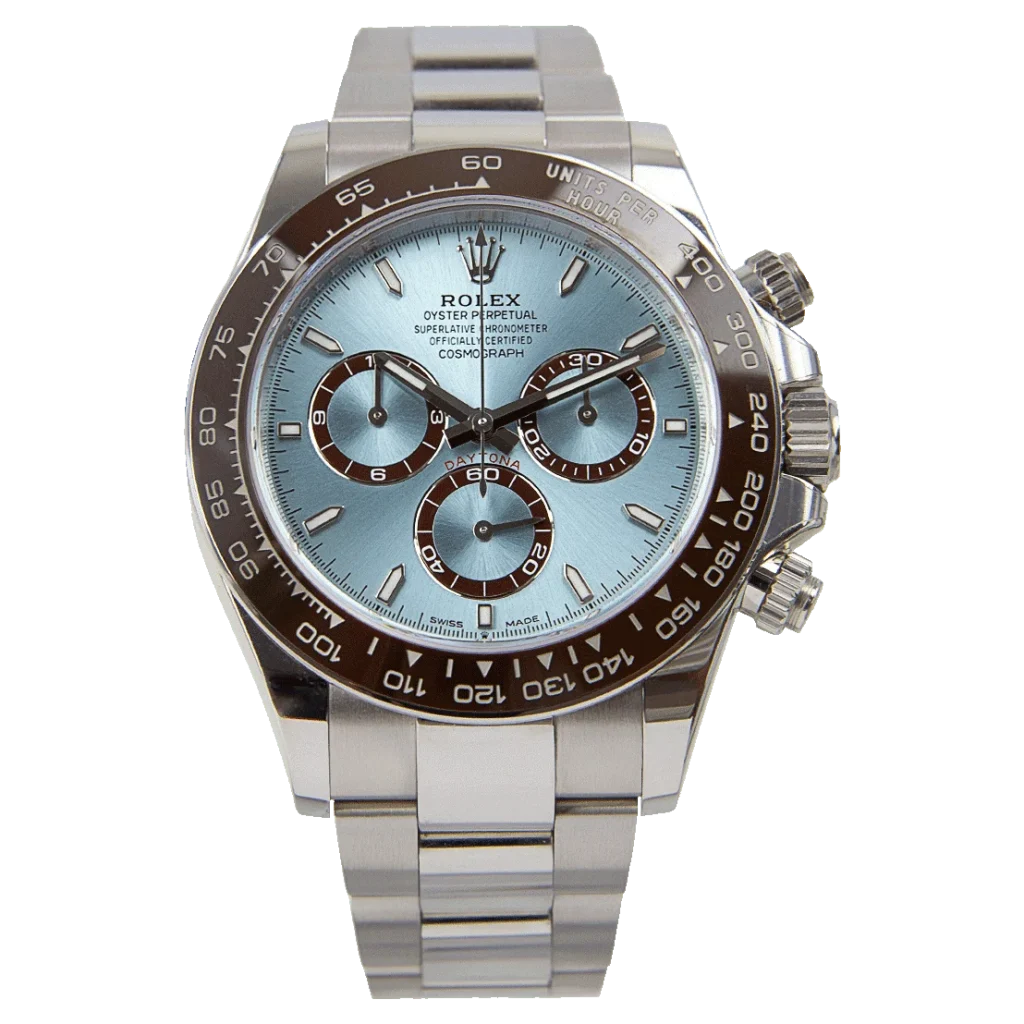
The dial architecture of the Cosmograph Daytona is one of the most studied layouts in Swiss watchmaking. Three subsidiary counters, positioned at 3, 6 and 9 o’clock, create a visual balance that is immediately legible under pressure. The contrasting colours of the sub-dials, most famously the reverse-panda and full-panda configurations, add depth and hierarchy to the information on display.
That layout has remained remarkably consistent across six decades of production. Minor refinements in proportion, case size, material and movement have evolved the watch without disrupting its identity. The Daytona of today is recognisably the same instrument as the Daytona of 1963.
That consistency is not conservatism. It is confidence.
The Reference That Changed Everything
For most of its early life, the Daytona was a commercially quiet watch. It sold modestly through the 1960s and 1970s, appreciated primarily by those who understood its purpose. Rolex reportedly had difficulty moving certain references, and dealers would sometimes include a Daytona as part of a bundle with more popular models.
That period of relative obscurity is now almost impossible to imagine.
The shift began in the 1980s, when a particular generation of collectors, investors and cultural figures began to discover what the watch world already understood quietly: that the Daytona was one of the best-designed sports chronographs ever made, that its earlier references were being produced in relatively small numbers, and that the combination of mechanical quality, design integrity and racing heritage created something genuinely rare.
The Paul Newman Effect
No single event shaped the Daytona’s cultural trajectory more dramatically than the association with Paul Newman.
Newman, one of the most celebrated actors of the 20th century and a serious racing driver in his own right, was frequently photographed wearing a particular variant of the Daytona. The reference he wore featured an exotic dial, as it became known, with Art Deco-inspired sub-dial markings and a distinctive visual character that set it apart from the standard production models.
When Newman’s personal Daytona sold at auction in 2017 for over 17 million US dollars, it set a world record for any wristwatch sold at auction at that time. The figure was extraordinary. But the more interesting story was what the sale confirmed: that the Daytona’s cultural weight had grown to a point where it transcended conventional watch collecting entirely.
It had become an object of genuine cultural significance.
What the Design Actually Gets Right
Strip away the mythology and the auction records, and what remains is a watch that earns its reputation on purely technical and aesthetic terms.
The case proportions are exactly right for a sports chronograph. The pushers are positioned and sized for practical operation. The bezel is functional without being cluttered. The dial communicates clearly at a glance. The bracelet, particularly in its Oyster configuration, integrates with the case in a way that feels purposeful rather than merely practical.
There is nothing decorative about the Daytona for the sake of decoration. Every element has a reason to be there. That kind of disciplined design thinking is rarer than it appears, and it is one of the clearest explanations for why the watch has aged so well across so many decades.
The Movement Question
Rolex’s transition to the in-house calibre 4130, introduced in 2000, marked a significant moment in the Daytona’s mechanical history. The movement brought column-wheel control, a vertical clutch for a smoother chronograph start and significantly improved reliability and serviceability compared to the Zenith El Primero-based movements used in the previous generation.
For collectors, the transition created two distinct collecting camps: those drawn to the character of the pre-2000 references and those who appreciate the technical purity of the modern movement. Both positions are well-founded. Together, they reflect how rich the Daytona’s history has become.
Rarity, Demand and the Waiting List Reality
The modern Daytona is one of the most difficult watches to acquire through authorised Rolex retailers. Waiting lists at Authorised Dealers run into years for the most sought-after references. The secondary market commands premiums that fluctuate with broader economic conditions but have historically remained well above retail for the most desirable configurations.
This reality shapes how most people encounter the Daytona. For many, the watch is a long-term aspiration rather than an immediate purchase. Something to work towards, to follow closely, to understand deeply before the opportunity to own one arrives.
That dynamic is part of what makes the Daytona so culturally resonant in the watch community. It is a watch people talk about, research, compare and anticipate. The journey of understanding it is part of the experience of wanting it.
The Daytona as a Weekly Drop
At Premium Watch Club, the [Weekly Drop](INTERNAL LINK: Weekly Drop) is designed around watches with immediate recognisability, strong cultural standing and the kind of aspirational pull that connects broadly with members at different stages of their collecting journey.
The Daytona is a natural fit.
It is the kind of reference that members who have been following watch culture for two weeks and those who have been collecting for twenty years can both immediately understand. Its story is accessible. Its design is legible. Its status is unambiguous without feeling exclusionary.
The [Monthly Drop](INTERNAL LINK: Monthly Drop) explores rarer and more technically complex collector targets. The [Special Drop](INTERNAL LINK: Special Drop) reserves space for the culturally unexpected. The Weekly Drop grounds the lineup in something everyone can point to and say: that is what this is all about.
The Cosmograph Daytona is exactly that watch.
Entering a skill-based competition for a piece like this is a different proposition to simply adding it to a wishlist. It is a way to engage actively with the watch, to learn its references and history as part of the entry process, and to make the aspiration feel genuinely within reach.
Beyond the Trophy
The Daytona has outlasted the racing era that created it, the auction records that defined its market, and every trend that has tried to displace it from the top of the collector hierarchy.
That kind of longevity is not accidental. It comes from a design that was right from the beginning: a watch built for a precise purpose, executed with complete integrity, and refined carefully enough over sixty years that each generation feels like a natural evolution rather than a departure.
The Cosmograph Daytona is not a watch that needs explanation. It simply needs to be on the wrist.
Some watches become iconic through scarcity. Others through marketing. The Daytona became iconic through design, heritage and an honesty of purpose that collectors have recognised and respected across every decade since its introduction.
That is what separates the truly great references from everything else. And that is why, sixty years on, the conversation around the Rolex Cosmograph Daytona shows no sign of slowing down.
A closer look at the chronograph built for speed, precision and one of the strongest stories in modern watch culture.
admin · PWC Journal
Explore the Current Drop